 CIRP
Research / Imaging and Perception Systems for Robotics / Sensor design and prototyping
FringeTact: Contact and Force Sensing with Photoelastic Imaging
A transparent tactile sensor reads patterns of light to locate contact and estimate normal and shear forces.
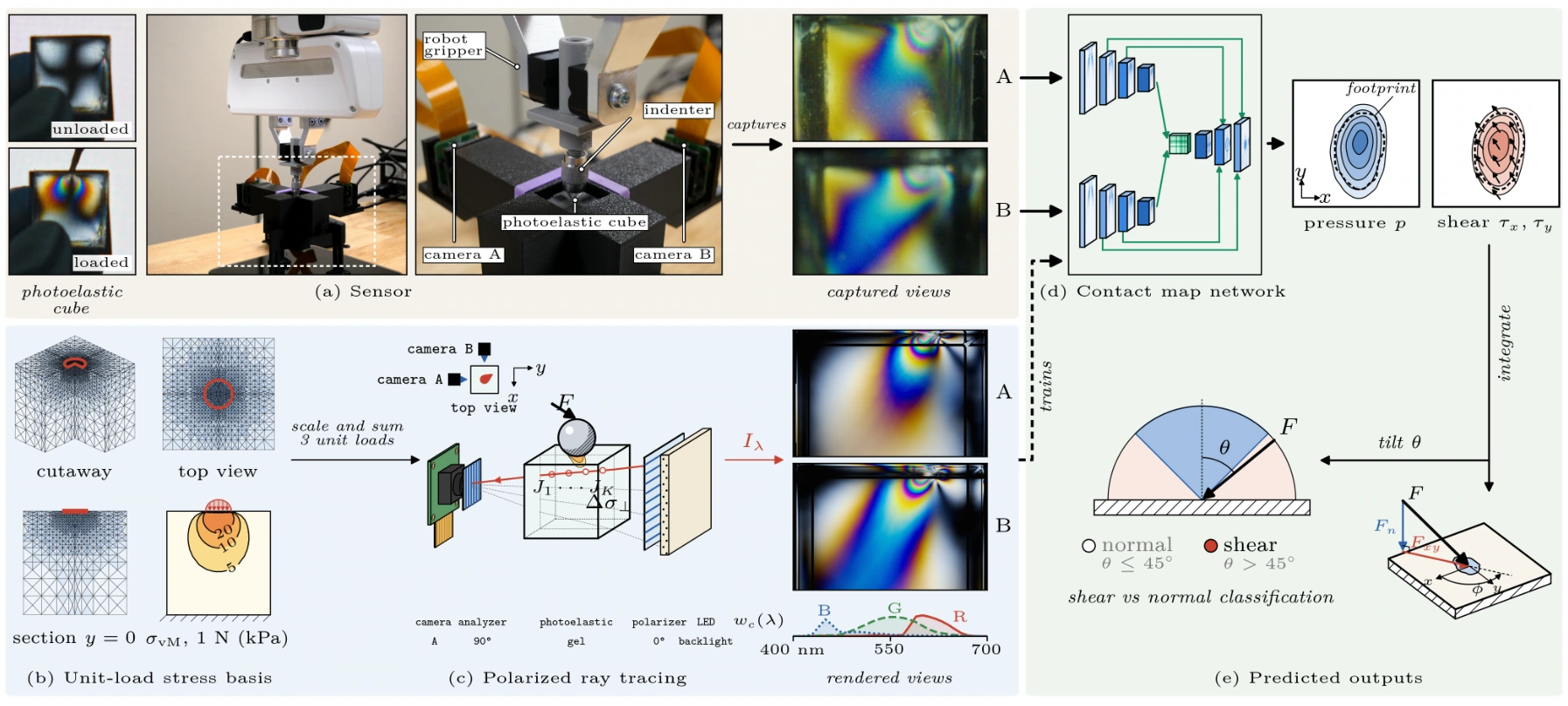
Project overview
When an object presses on a photoelastic block, stress changes the polarization of light passing through it. Front and side cameras observe the resulting fringes. The same transparent surface also lets a camera see the object in contact.
Method
A finite-element model simulates stress inside the block. A polarized-light renderer translates that stress into images used to train a network, which is then fine-tuned on real camera pairs. The network estimates contact footprint, pressure and shear, and integrates them to recover net force.
Project media
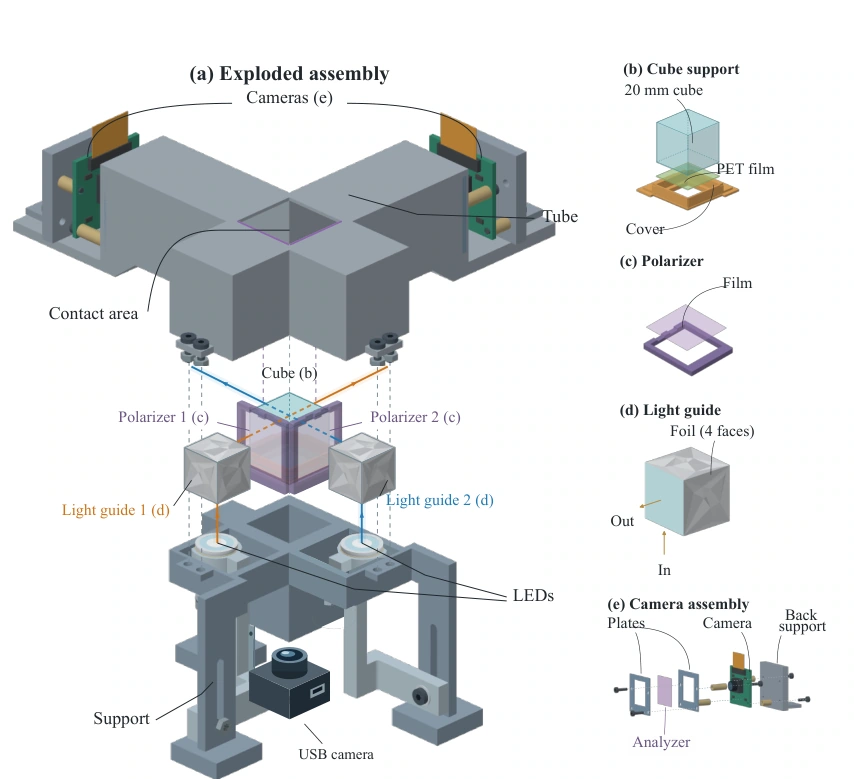
Project team
Project leads
Feimei Chen · Asif Sijan
Principal investigator
Huaijin Chen
Contributors
Munir Zarea · Roxanne Kate Balanay · Riki MacMillan · Christian Moore · Tyler R. Ray · Frankie Zhu · Akshat Dave · Tianlu Wang